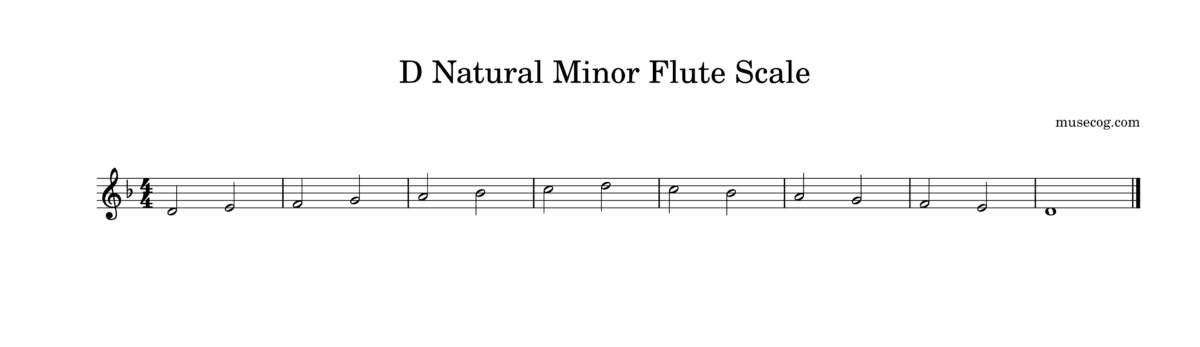
The D minor scale on flute has its tonic on D natural, and it also has the pitches D, E, F, G, A, B-flat, and C. The key signature of this scale has one flat, which is B-flat. The D minor scale is relative to F major scale, parallel to the D major scale, dominant to the A minor scale, and subdominant to the G minor scale.
There are three different D minor scales for the flute:
- D natural minor
- D harmonic minor
- D melodic minor
Click here to see the finger placement chart for D minor notes.
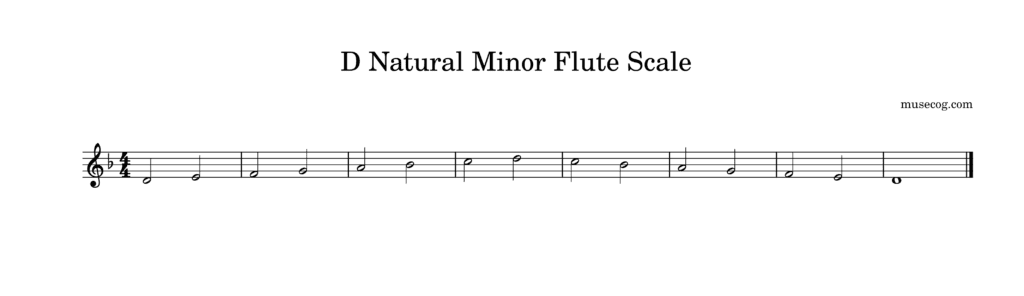
D natural minor scale on the flute
If you would like to play the D natural minor scale on the flute correctly, you can use the two-octave scale chart below to know what notes to flatten or sharpen.
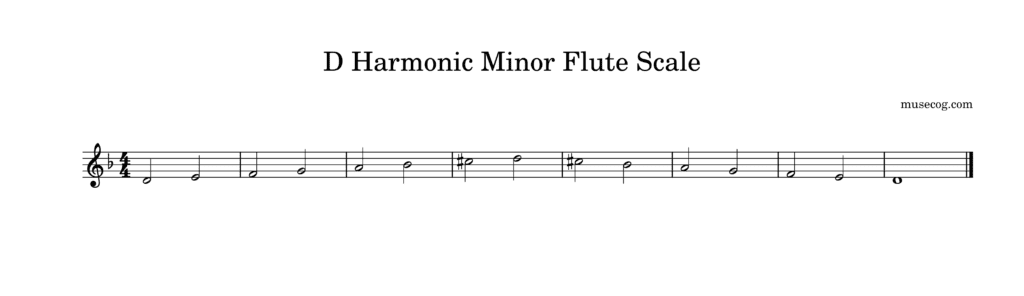
D harmonic minor scale on flute
The D harmonic minor scale on the flute has a sharpened seventh note, which is called C#. This alteration creates a distinct sound and distinguishes it from the D natural minor scale. Below is a two-octave scale chart for D harmonic minor on the flute.
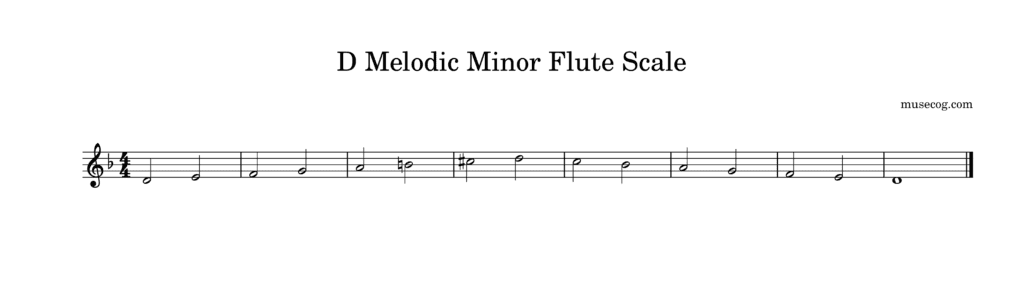
D melodic minor scale on flute (ascending and descending)
The D melodic minor scale on the flute differs from the D natural minor scale because it has sharpened sixth and seventh notes, B-flat and C natural respectively when ascending, and those notes are naturalized and flattened when descending. Below is a two-octave scale chart for D melodic minor on flute.
D minor arpeggio for flute
The D minor arpeggio notes are D, F, and A. An arpeggio is a musical pattern where the notes of the flute are played one after the other. In the case of a D minor arpeggio, the notes of the D minor chord (D, F, and A) are played in succession. The arpeggio can be played in different octaves and finger placements of the flute.