Skip to content
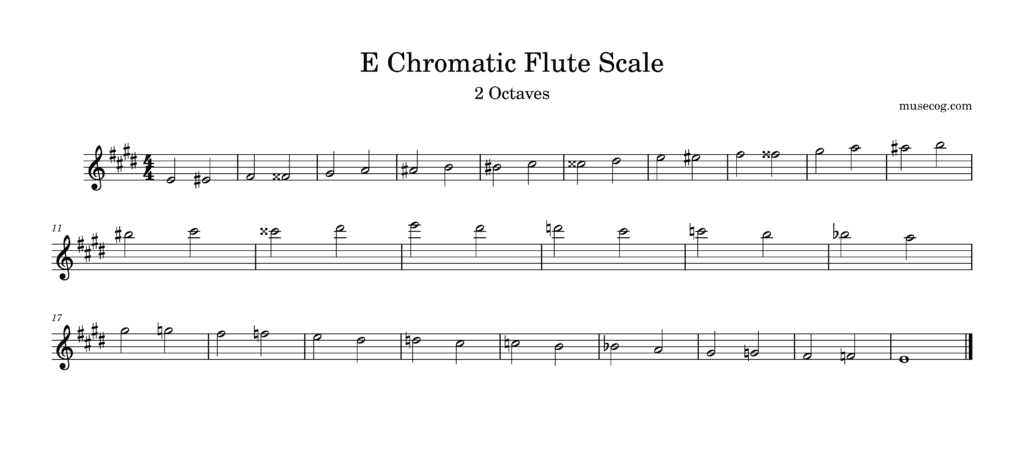
 The E chromatic scale for flute is a specific type of chromatic scale that starts and ends on E on the flute. It has a key signature of four sharps and includes all the notes in the Western musical system, from E to E, played in half-steps. Here are the 2 octaves notes in the E chromatic scale for the flute:
Ascending (using sharps): E, E♯, F♯, F♯♯, G♯, A, A♯, B, B♯, C♯, C♯♯, D♯, E, E♯, F♯, F♯♯, G♯, A, A♯, B, B♯, C♯, C♯♯, D♯, E.
Descending (using flats): E, D♯, D♮, C♯, C♮, B, B♭, A, G♯, G♮, F♯, F♮, E, D♯, D♮, C♯, C♮, B, B♭, A, G♯, G♮, F♯, F♮, E.
Fingering Techniques for E Chromatic Scale
Playing the E chromatic scale on a flute requires some specific fingering techniques to play each note accurately. Here is the fingering chart for playing the E chromatic scale on a flute:
Tips for Practicing the E Chromatic Scale on the Flute
Practicing the E chromatic scale on the flute can be challenging, especially for beginners. Here are some tips to make your practice sessions more effective:
- Start Slow: Begin by playing each note slowly and accurately. Focus on producing a clear and beautiful sound for each note.
- Use a Metronome: Practice the scale with a metronome to improve your timing and accuracy. Gradually increase the speed as you get more comfortable.
- Focus on the Transitions: Pay attention to the transitions between each note. Smoothly transitioning between each note.
- Practice in Different Octaves: Practice playing the E chromatic scale in different octaves to develop your technique and finger coordination.
- Warm-up: Always start your practice session with a warm-up routine to prepare your fingers and body for playing.
- Use a Mirror: Practicing in front of a mirror can help you observe your hand position, posture, and embouchure.
- Break It Down: Break the scale down into smaller parts and practice each part separately. Then, put them all together.
- Record Yourself: Record yourself playing the E chromatic scale and listen to the recording to identify areas for improvement.
See also: E major Scale
Common Mistakes to Avoid
Playing the E chromatic scale on the flute can be challenging, and making mistakes is easy. Here are some common mistakes to avoid:
- Poor Finger Coordination: Make sure your fingers are moving in sync to play each note accurately.
- Incorrect Hand Position: Keep your hands in the correct position on the flute to avoid squeaking or producing incorrect notes.
- Incorrect Embouchure: Ensure that your embouchure is correct to produce a clear and beautiful sound.
- Rushing: Take your time to play each note accurately and avoid rushing.
- Poor Breath Control: Maintain good breath control to produce a consistent and beautiful sound throughout the scale.
See also: E major arpeggio
How to Apply the E Chromatic Scale in Practice
The E chromatic scale can be used in various musical contexts, including warm-up routines, technical exercises, and solo pieces. It’s an essential scale for building a flutist’s technique, finger coordination, and intonation.
Here are some ways you can apply the E chromatic scale in practice:
- Warm-up Routine: Use the E chromatic scale as part of your warm-up routine to prepare your fingers and body for playing.
- Technical Exercises: Practice playing the E chromatic scale in different rhythms and articulations to improve your technique.
- Solo Pieces: Use the E chromatic scale in solo pieces to showcase your technique and musicality.