
Gothic architecture is one of the most recognisable and enduring styles in Western building history. Emerging in 12th-century France and flourishing until the 16th century, Gothic design transformed cathedrals, castles, universities, and civic buildings with its characteristic pointed arches, ribbed vaults, flying buttresses, and spectacular stained glass. Unlike the heavy, fortress-like Romanesque that preceded it, Gothic architecture reached toward heaven — literally and figuratively — with soaring verticality and an obsession with light.
Whether you are an architecture student studying stylistic evolution, a homeowner seeking inspiration for a Gothic Revival project, or simply someone who loves the drama of a rose window and the rhythm of a vaulted ceiling, these 12 Gothic architecture designs cover the essential building types and structural innovations of the era. Each design represents a significant contribution to the Gothic canon.
1. The French Gothic Cathedral
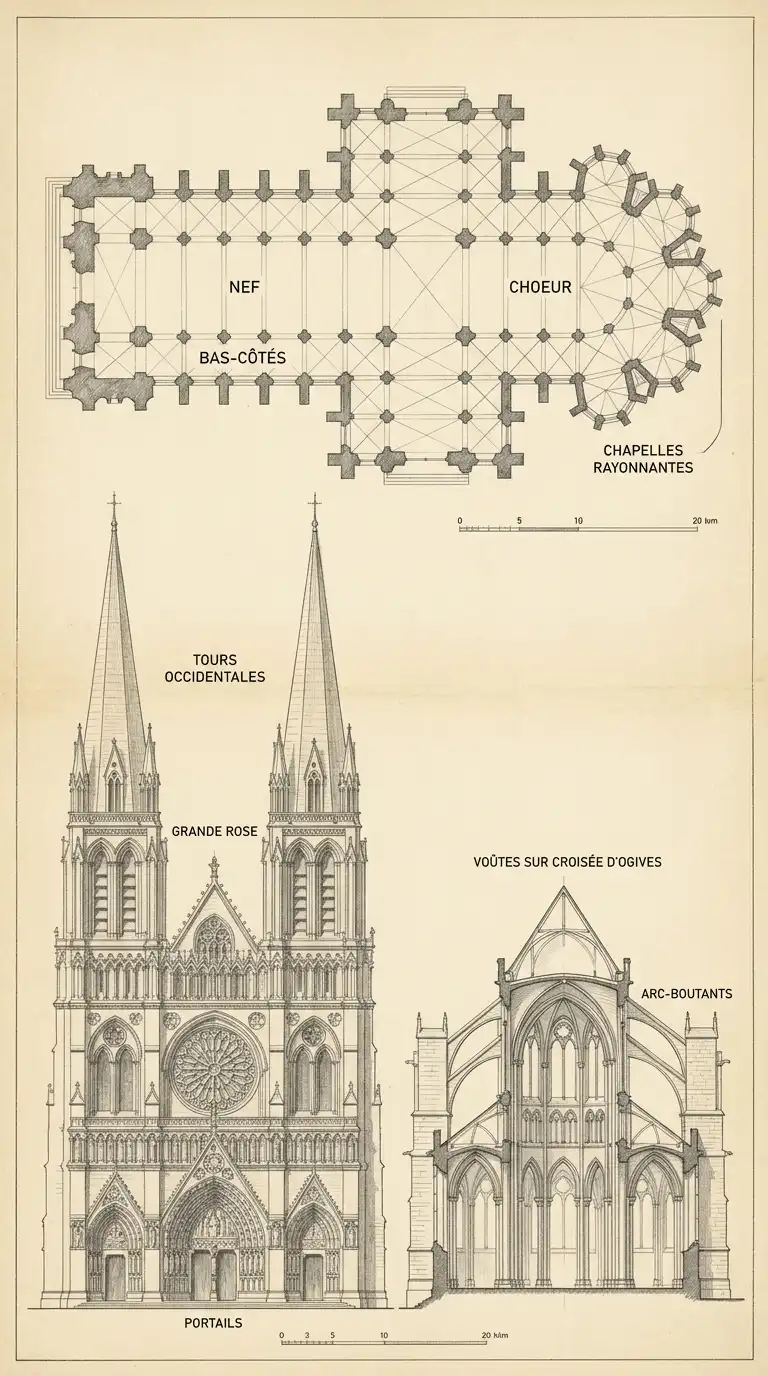
The French Gothic cathedral is the purest expression of High Gothic design. Chartres, Amiens, Reims, and Notre-Dame de Paris set the standard: a Latin cross plan, a soaring nave at least three times as tall as it is wide, a deep choir for the clergy, an ambulatory with radiating chapels, and twin towers framing the west facade.
The structural system is the defining innovation. Pointed arches distribute weight more efficiently than round arches, allowing taller walls and thinner columns. Ribbed vaults concentrate forces into specific points, which are then carried by flying buttresses outside the building. This external support system eliminates the need for massive solid walls, which in turn allows vast areas of stained glass. The result is a building that feels weightless despite its immense scale.
Quick Tips
- The west facade should have two towers of equal or near-equal height, typically 60-80 metres tall.
- The nave elevation has four levels: arcade, gallery, triforium, and clerestory.
- The rose window, typically 8-12 metres in diameter, is centred on the west facade and transept ends.
2. The English Gothic Perpendicular Church
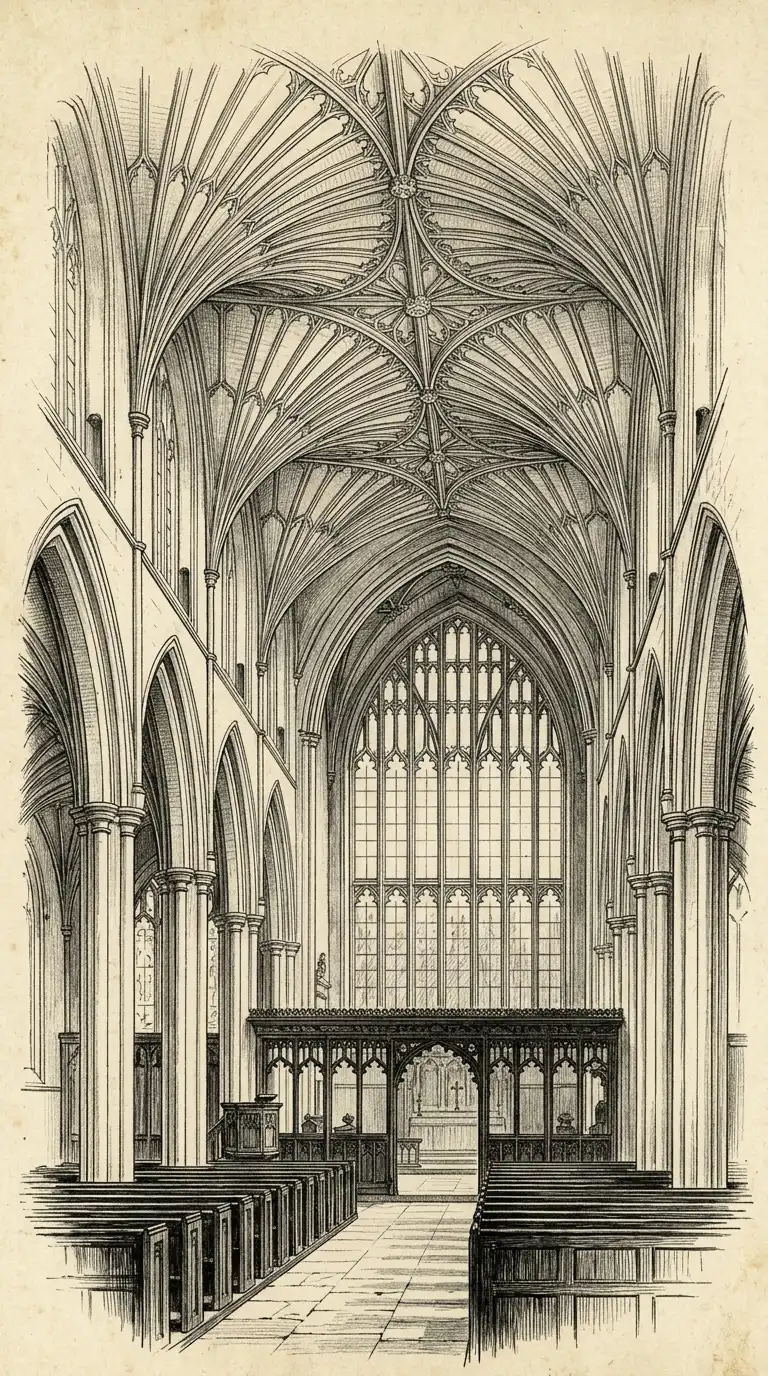
English Gothic developed differently from French Gothic. While French cathedrals emphasised height and vertical continuity, English Gothic — particularly the Perpendicular style of the 14th and 15th centuries — celebrated horizontal lines, elaborate vaulting, and enormous windows that fill entire wall surfaces.
The defining feature of Perpendicular design is the window tracery: vertical mullions that rise uninterrupted from the sill to the arch, creating a grid-like pattern that gives the style its name. Fan vaulting, a uniquely English invention, spreads from a single column like an opening fan, creating a complex web of ribs that seems to float overhead. King’s College Chapel in Cambridge and Gloucester Cathedral are the masterpieces of this style.
Quick Tips
- Perpendicular windows have strong vertical mullions with horizontal transoms creating a grid pattern.
- Fan vaulting requires precise stereotomy — each stone is cut to a unique geometry.
- English cathedrals typically have a single central tower, not twin western towers.
3. The German Hall Church (Hallenkirche)
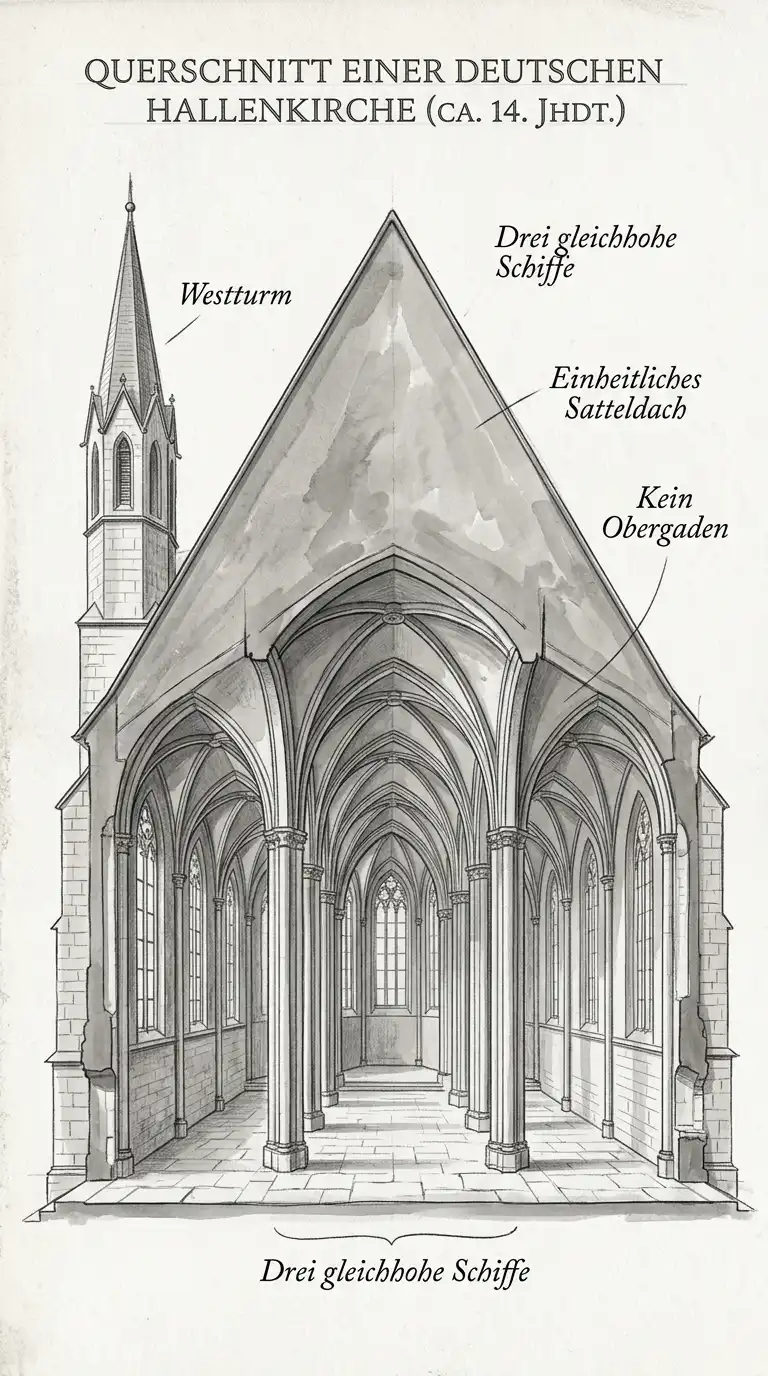
The German Hall church, or Hallenkirche, solves a different problem than the French cathedral. Instead of a tall central nave with lower side aisles, the Hall church makes all three aisles the same height. The result is a wide, unified interior space without the dramatic vertical drop of French Gothic.
This design maximises floor area within a given footprint, making it practical for urban parish churches where land was limited. The aisle arcades are correspondingly taller, and the roof structure must span the entire width of the church. St. Stephen’s in Vienna and St. Mary’s in Lübeck are the most famous examples. The exterior is often simpler than French cathedrals, with a single tower rather than twin towers.
Quick Tips
- All three aisles must have the same or nearly the same ceiling height.
- The central nave is typically only 1.5 to 2 times the height of the side aisles, not 3 times.
- The roof is a single, steeply pitched gable covering all three aisles.
4. The Italian Gothic Basilica
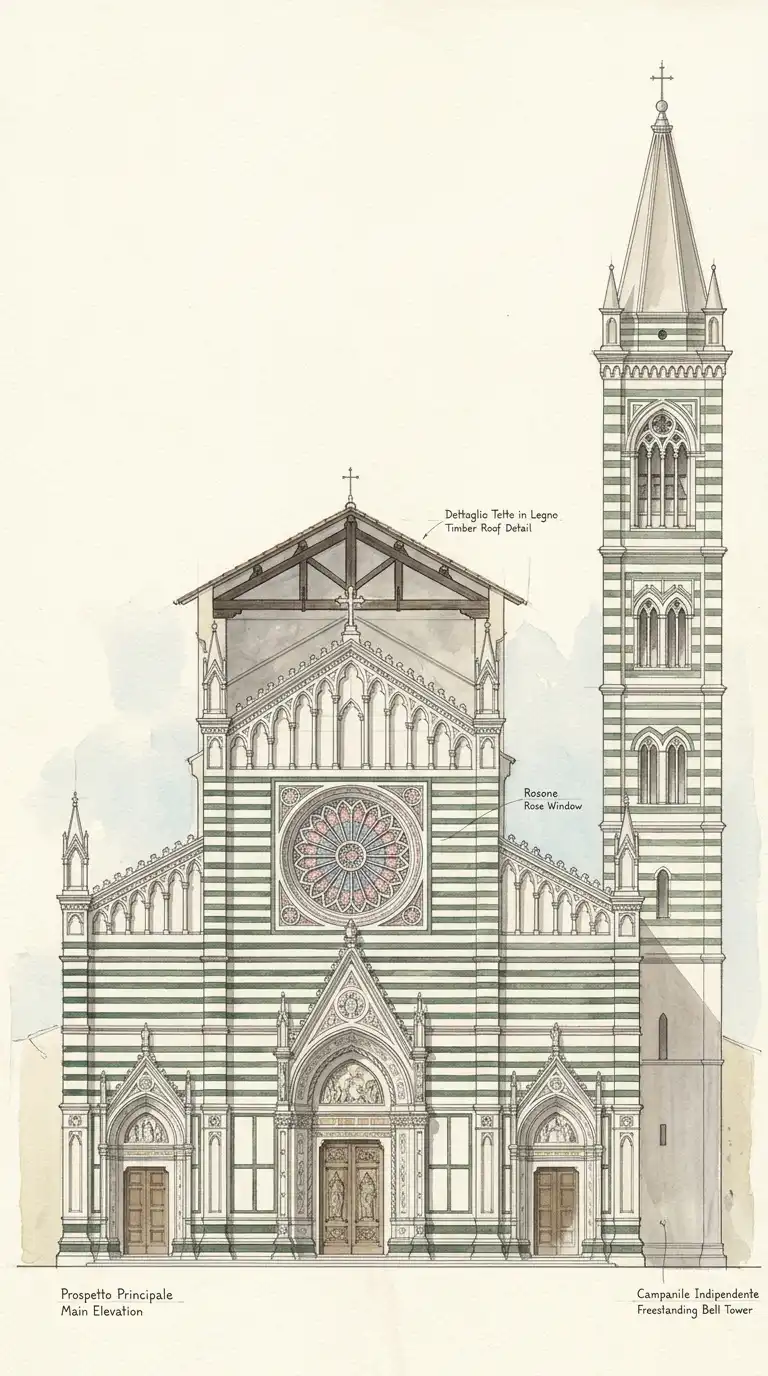
Italy never fully embraced the structural daring of French Gothic. Italian Gothic churches remained closer to the earlier Romanesque and early Christian basilica tradition: wide naves, wooden roofs instead of stone vaults, and an emphasis on wall surfaces rather than stained glass.
What Italian Gothic lacks in structural innovation, it compensates for in decorative richness. Striped marble in alternating colours, intricate stone tracery, and elaborate Cosmatesque mosaic floors are characteristic. The campanile, or freestanding bell tower, is often separated from the church itself — Florence’s Giotto’s campanile is the most famous example. The overall effect is more horizontal than vertical, more colourful than shadowy.
Quick Tips
- The nave is typically wide and low, often covered by an open timber roof rather than stone vaults.
- Exteriors use polychrome marble — white and green or white and pink striped.
- The campanile is often freestanding, not integrated into the main facade.
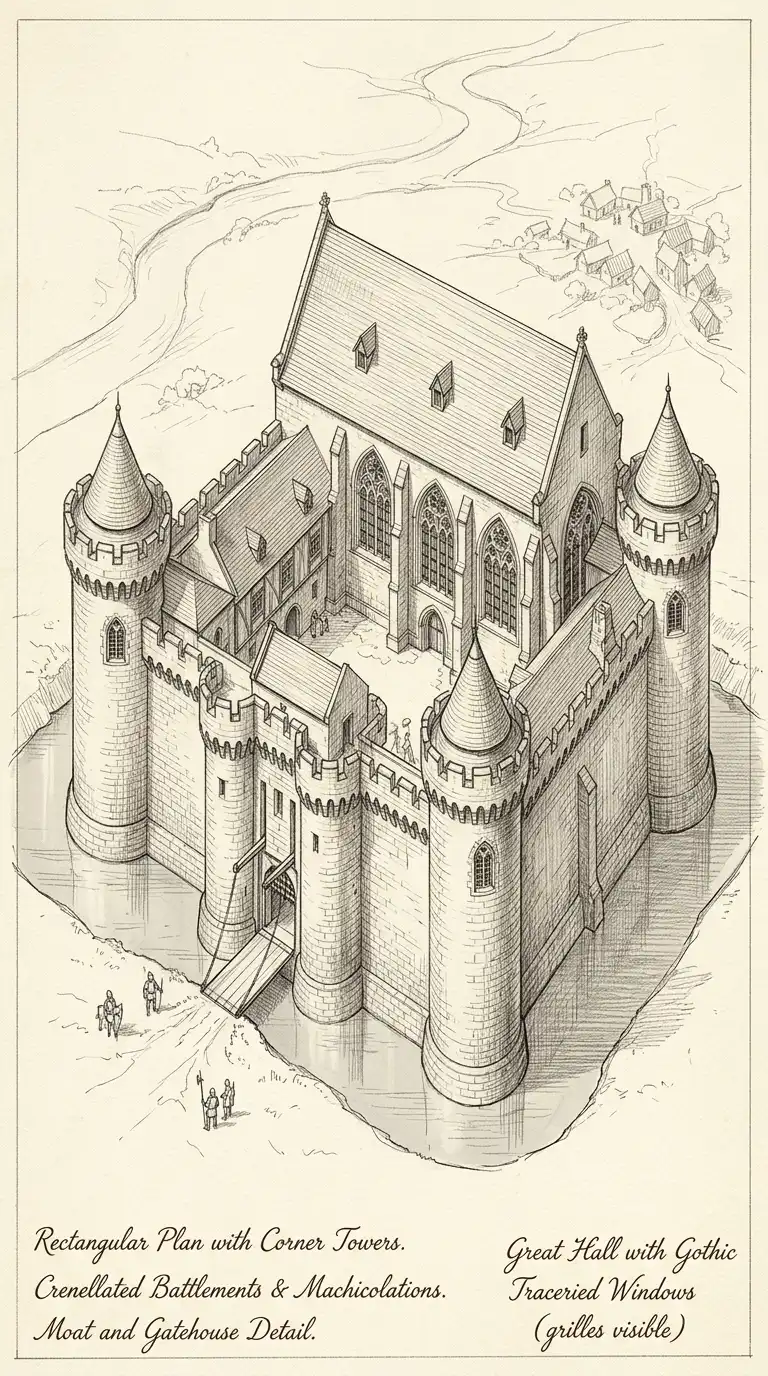
5. The Gothic Castle
Gothic architecture was not limited to churches. Castles adopted Gothic details for both defensive and residential purposes. The Gothic castle retains the defensive features of earlier fortresses — thick walls, moats, drawbridges, crenellations — but adds larger windows, more elaborate fireplaces, vaulted ceilings in great halls, and decorative tracery.
The transition from military fortress to comfortable residence is visible in the window sizes. Early Gothic castles have narrow arrow slits. Late Gothic castles have large, traceried windows with glass, admitting light while maintaining security through iron grilles. The great hall becomes the architectural focus: a double-height space with a hammerbeam roof and a massive fireplace at one end. Bodiam Castle in England and Château de Pierrefonds in France exemplify the type.
Quick Tips
- The great hall should be double-height with a hammerbeam or vaulted ceiling.
- Windows should be larger than Romanesque castles but still secured with iron grilles.
- Crenellations and corner towers must be shown as functional defensive elements.
6. The Gothic University College
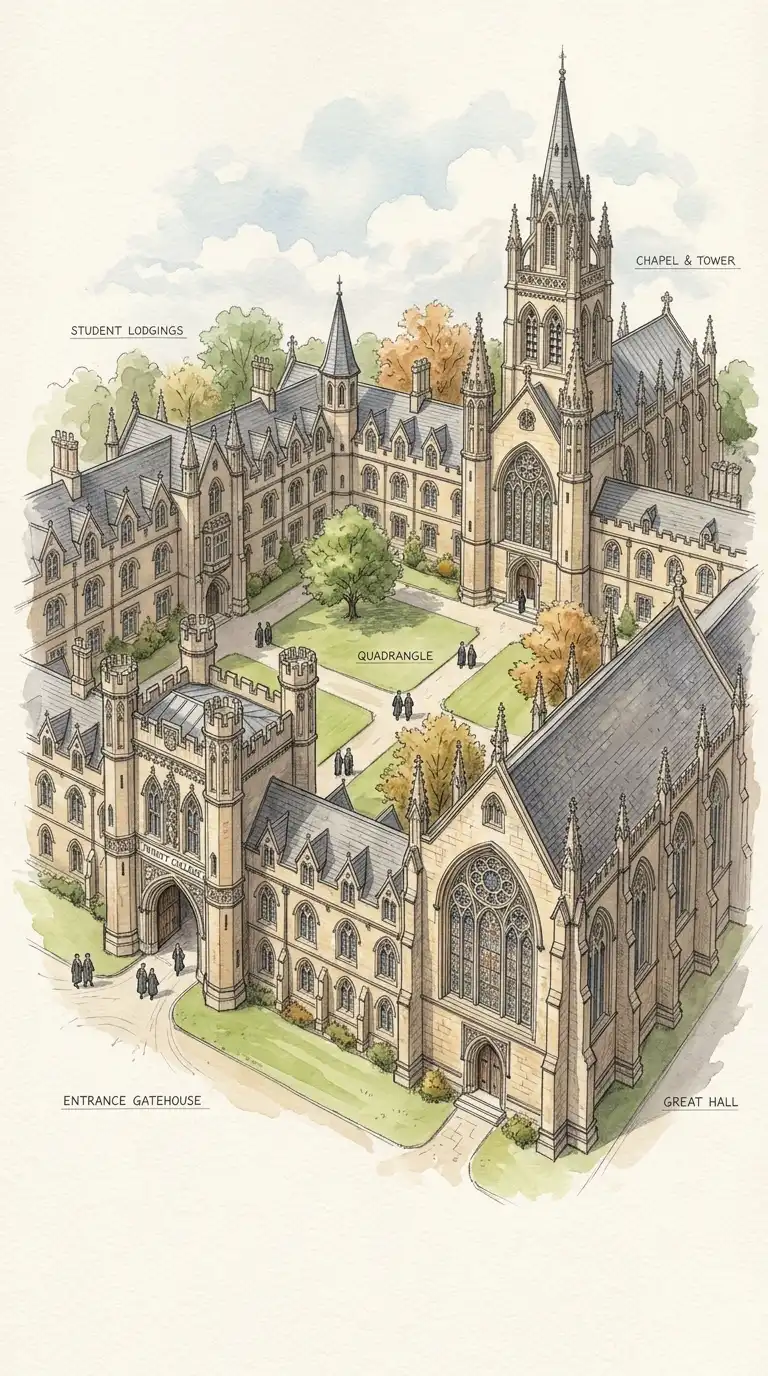
The Gothic Revival of the 19th century found its ideal expression in university buildings. Oxford and Cambridge colleges, as well as American universities like Yale and Princeton, adopted Gothic as the style of learning — associating medieval scholarship with their own aspirations.
The Gothic college typically follows a courtyard plan, with the chapel and library as the most ornate buildings. The dining hall is modelled on the medieval great hall: a double-height space with a hammerbeam roof, large windows, and a high table at one end. Gates and gatehouses mark the entrance, often with portcullises and heraldic decoration. The style suggests tradition, permanence, and scholarly seriousness.
Quick Tips
- The courtyard plan should be quadrangular, with buildings on all four sides.
- The chapel should be the tallest building, followed by the library and hall.
- The entrance gatehouse should be ornamented with heraldry, finials, and a large wooden door.
7. The Gothic Town Hall
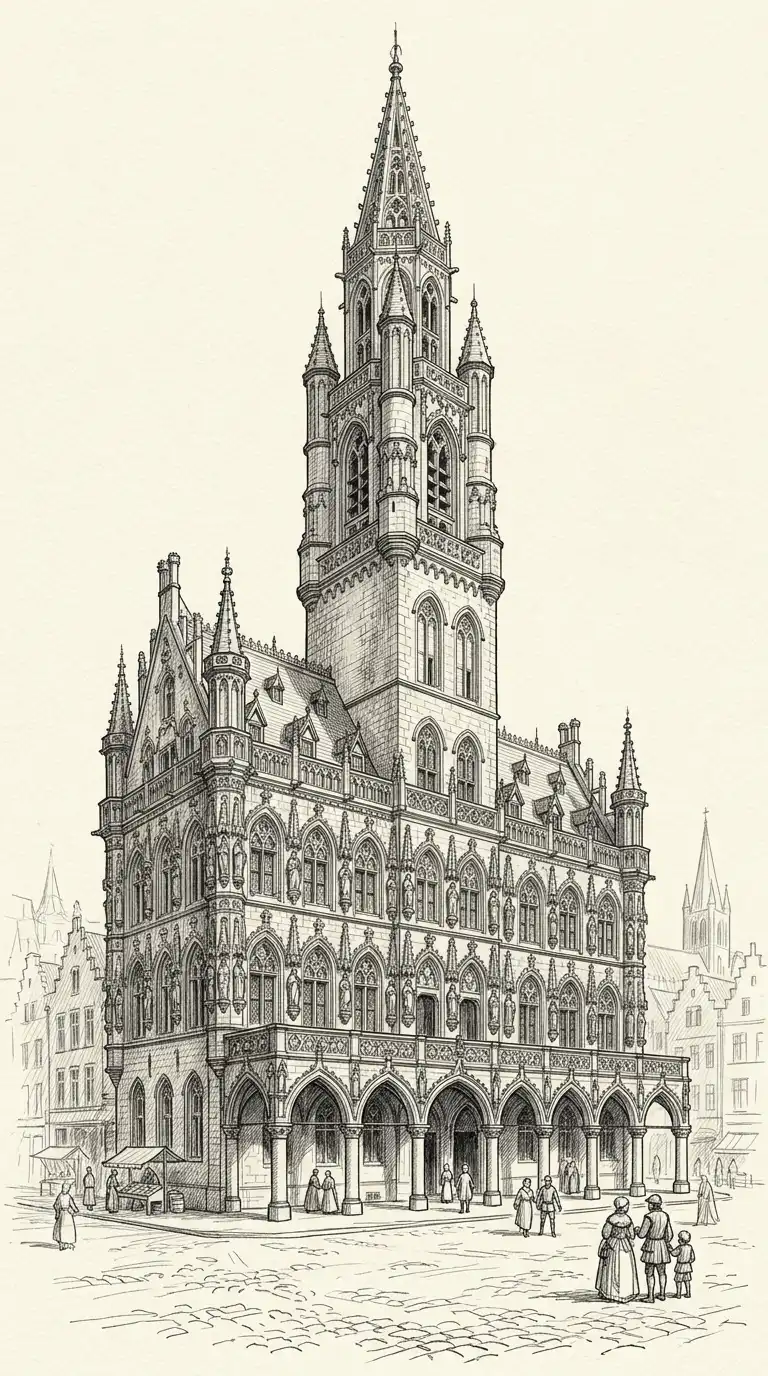
Medieval cities expressed their civic pride through Gothic town halls. These buildings combined administrative functions — council chambers, law courts, treasuries — with public spaces for markets and ceremonies. The Flemish Gothic town halls of Brussels, Leuven, and Ghent are the most spectacular examples.
The facade is asymmetrical, with a tall belfry tower rising from one corner or the centre. The tower symbolises civic authority and originally held the town charter, bells, and a watchman. Below the tower, a large entrance leads to an internal courtyard or a grand staircase. The council chamber is often on the first floor, reached by an external staircase, signifying that justice was administered above the chaos of the market.
Quick Tips
- The belfry tower should be the dominant element, visible from throughout the city.
- The facade should be richly decorated with statues of local saints, rulers, and allegorical figures.
- The ground floor should have an open arcade for markets or covered walkways.
8. The Gothic Bridge
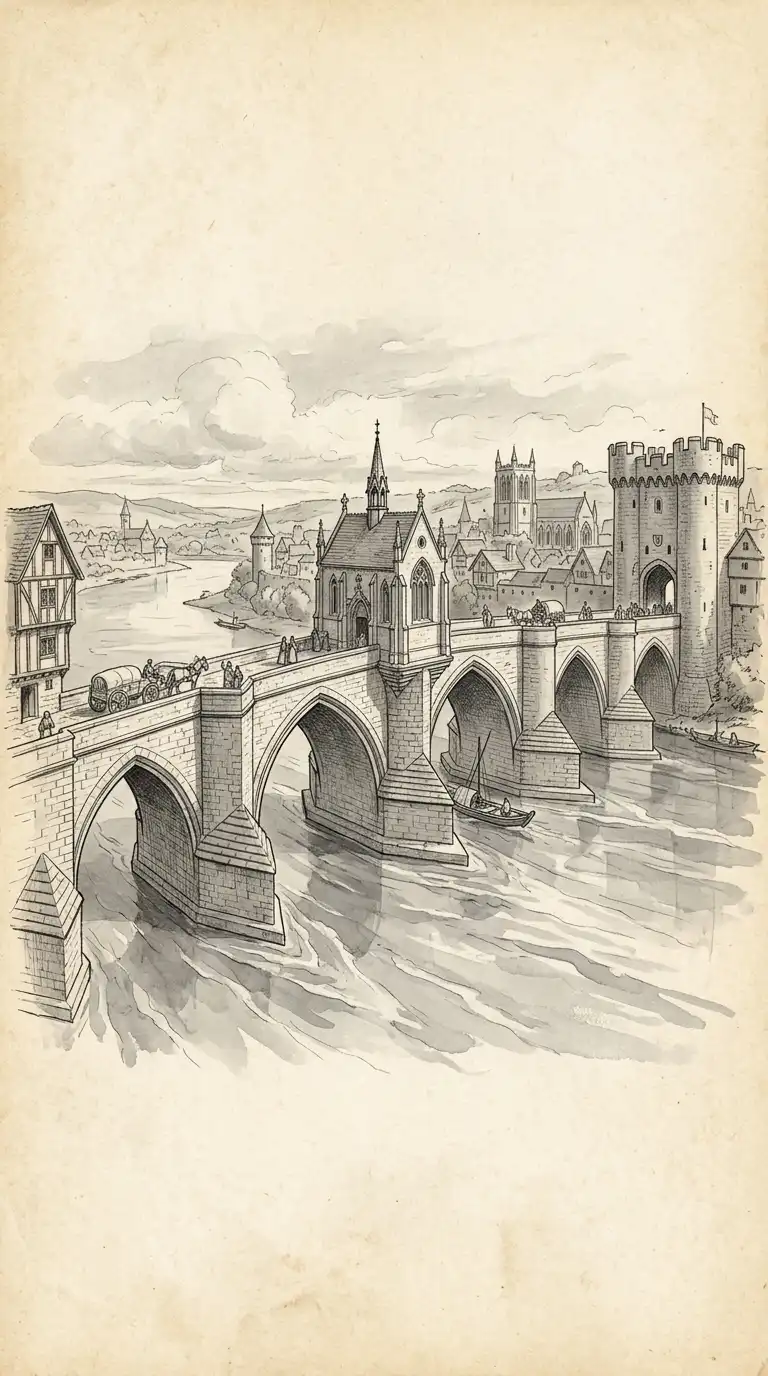
Gothic engineers built some of the most beautiful bridges in architectural history. The medieval stone bridge combined practical engineering with aesthetic sophistication: pointed arch ribs, cutwaters with pedestrian refuges above, and often a chapel or tower at the centre or ends.
The Pont d’Avignon (Saint-Bénézet Bridge) in France and the Charles Bridge in Prague are the most famous survivors. The pointed arch is the key structural innovation: it reduces horizontal thrust compared to a round arch, allowing bridges to be built on shallower foundations. Cutwaters — triangular projections on the upstream side of each pier — reduce scour and provide refuge for pedestrians when carts pass.
Quick Tips
- Pointed arches should vary in span, with larger arches over the main channel.
- Cutwaters should extend upstream and often have small chapels or statues on top.
- The bridge deck should be wide enough for two-way cart traffic plus pedestrian refuges.
9. The Gothic Guildhall
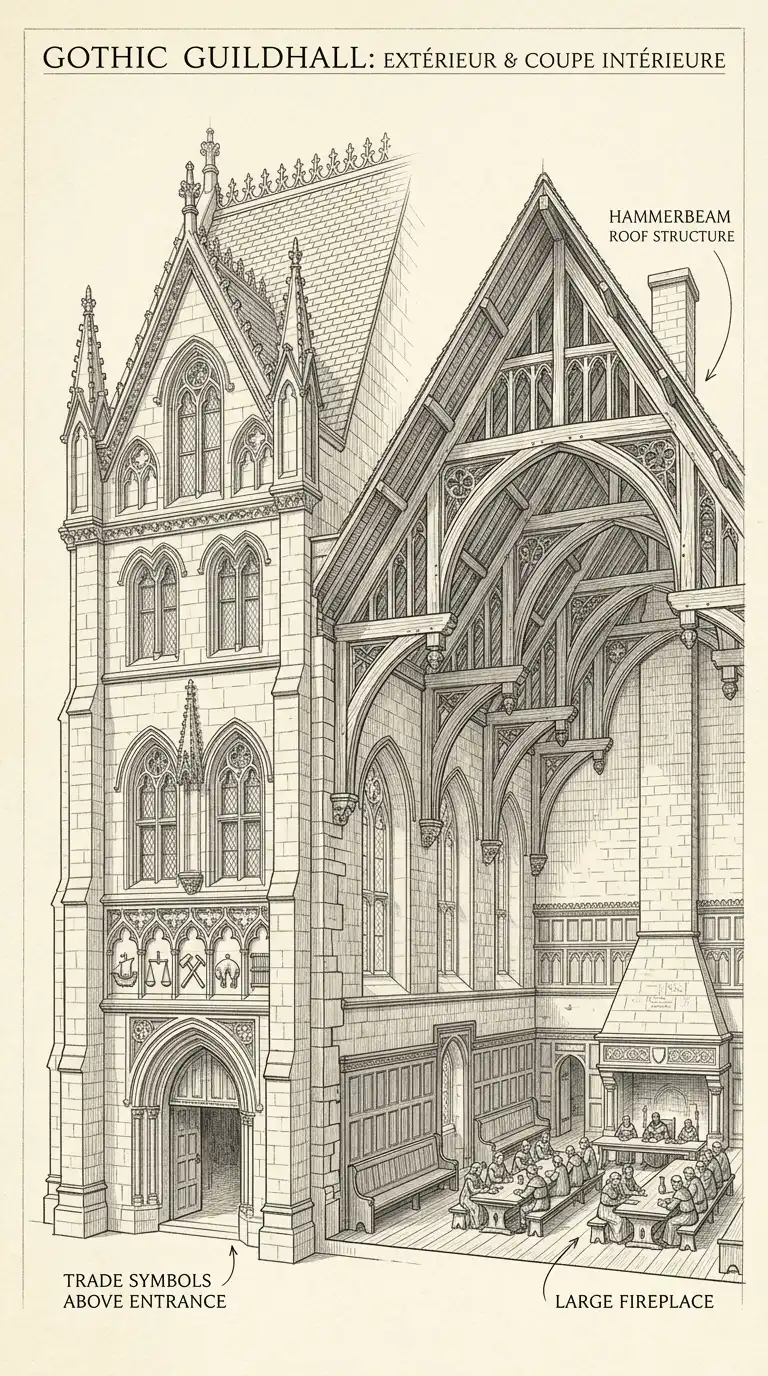
Medieval trade guilds built elaborate halls to display their wealth and regulate their trades. The Gothic guildhall typically includes a large meeting hall for guild members, a smaller court room for disputes, a treasury, and sometimes a covered market or exchange on the ground floor.
The facade announces the guild’s trade through sculpture and symbolism. Butchers’ guilds feature carved animals. Cloth merchants’ guilds show textile production. The roof structure is often elaborate, with hammerbeam trusses spanning the width of the meeting hall without internal columns. The Guildhall in London (surviving despite the Great Fire and the Blitz) and the Hôtel de Ville in Brussels are outstanding examples.
Quick Tips
- The meeting hall should be a single, unobstructed space with a hammerbeam or arched roof.
- The facade should include carved symbols of the specific trade.
- A prominent chimney indicates a fireplace or hearth for heating the meeting hall.
10. The Gothic Market Cross
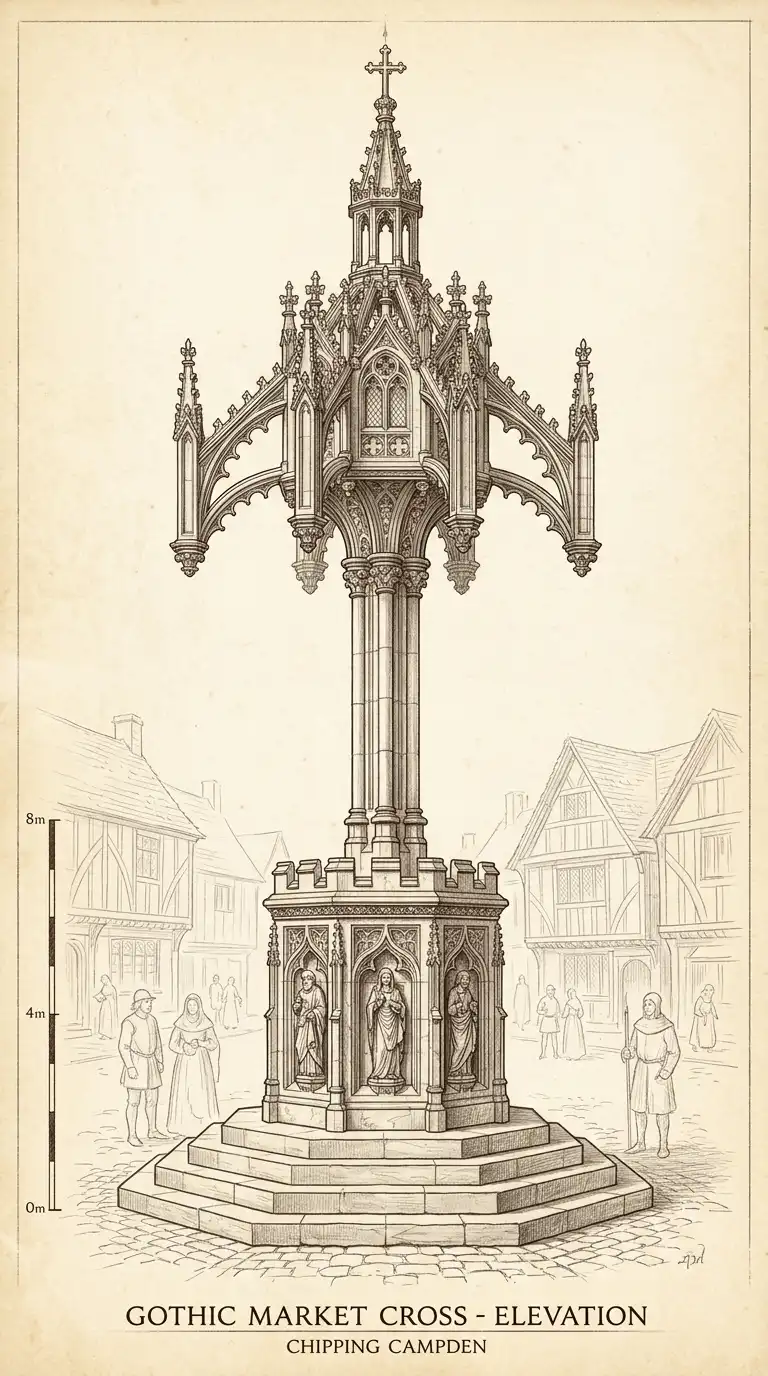
At a smaller scale, the Gothic market cross is one of the most charming and widespread Gothic designs. Found in town squares across England and France, the market cross is a freestanding stone structure marking the centre of the market and serving as a platform for proclamations.
The typical market cross has a stepped base, a clustered column or polygonal shaft, and a pinnacled canopy above. The canopy protects the person making announcements from rain. Niches around the base once held statues of saints or local worthies. Some market crosses, like the Eleanor Crosses in England, were memorials as well as market markers.
Quick Tips
- The base should have at least two or three steps leading to the shaft.
- The canopy should be supported by flying buttresses or thick corner piers.
- Statue niches should face the four cardinal directions.
11. The Gothic Chapter House
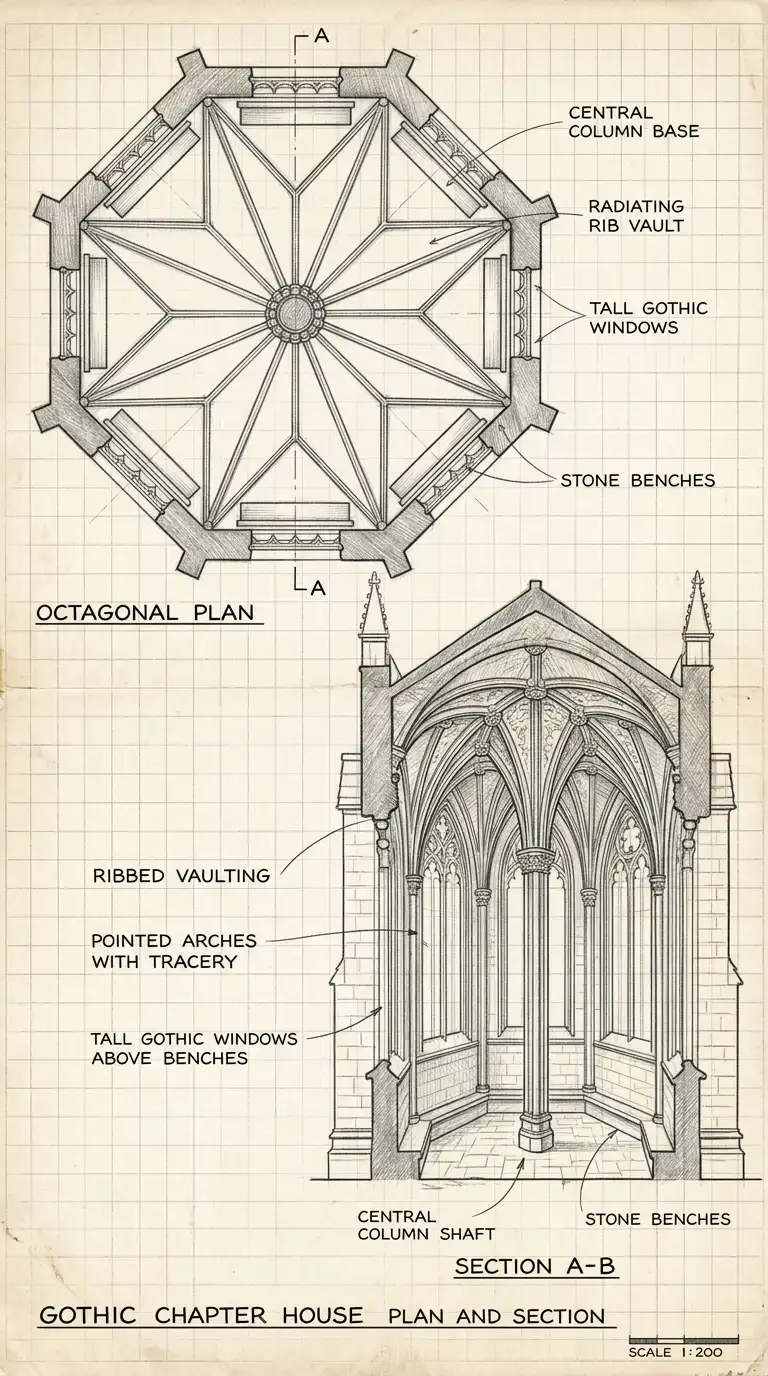
The chapter house was the meeting room for the monks or canons of a cathedral or abbey. Gothic chapter houses are often polygonal or circular, with a single central column supporting a vaulted ceiling — a space that is both functional and symbolic, representing the community gathered around its leader.
The most famous is the Chapter House at York Minster, an octagon with a central column from which ribs radiate to the outer walls. The walls are almost entirely glass, flooding the space with light. Benches line the walls for the seated monks. The entrance is typically through a richly decorated doorway from the cloister.
Quick Tips
- The plan should be polygonal (typically octagonal) or circular.
- A single central column should support a vault radiating to the outer walls.
- Windows should fill most of the wall area above bench height.
12. The Gothic Revival House
The Gothic Revival of the 18th and 19th centuries brought Gothic details into domestic architecture. Horace Walpole’s Strawberry Hill, A.W.N. Pugin’s houses, and countless Victorian Gothic villas adapted cathedral details for residential use.
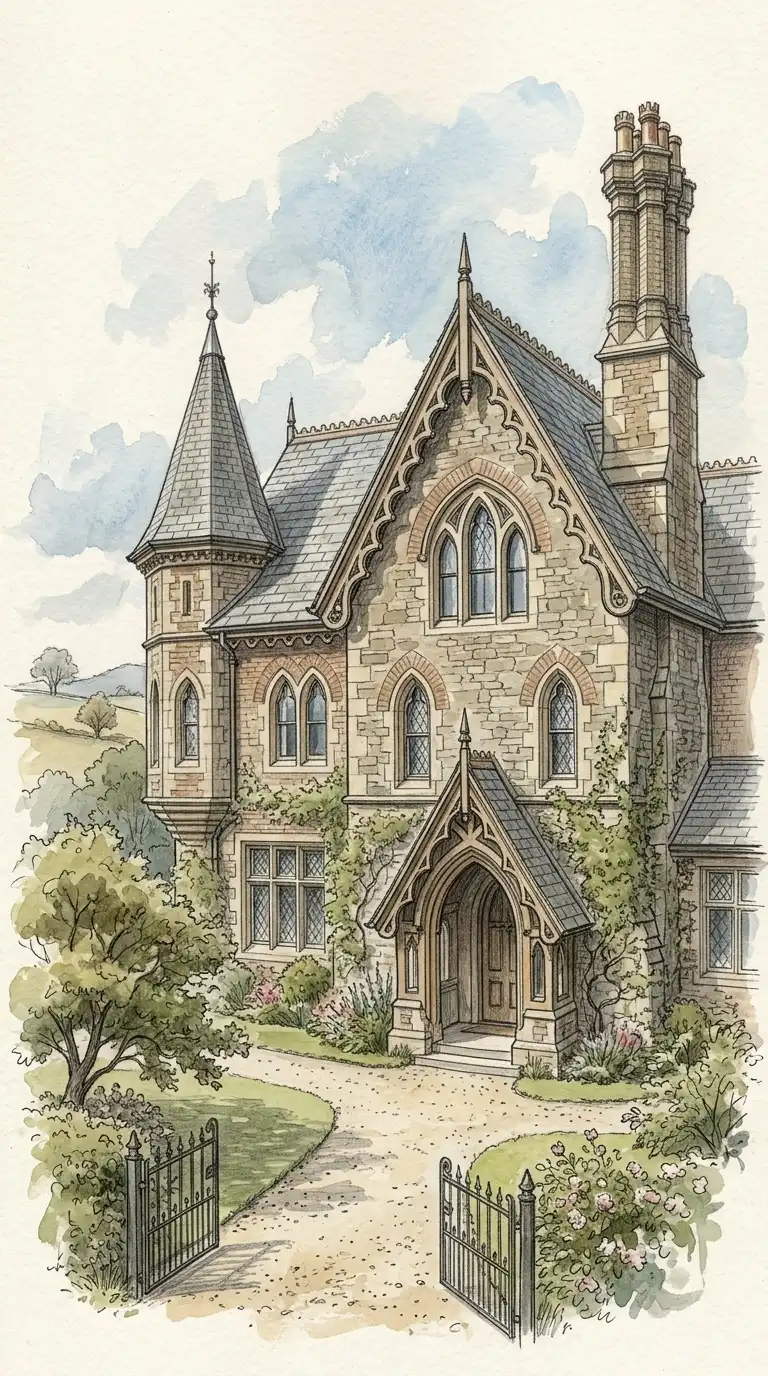
The Gothic Revival house features steeply pitched roofs, pointed arch windows often in groups of two or three, decorative bargeboards on the eaves, and a prominent chimney stack. Interiors include vaulted entrance halls, arched doors, and Gothic-style fireplaces with hooded surrounds. The style suggests romance, history, and picturesque irregularity — a deliberate rejection of classical symmetry.
Quick Tips
- The roof should be steeply pitched, ideally 45 degrees or steeper.
- Windows should be pointed arch or have Gothic tracery in the upper sashes.
- The facade should be asymmetrical, with a prominent tower or bay window.
Final Thoughts
Gothic architecture spans nearly a millennium, from the first pointed arches of Saint-Denis to the Victorian Gothic houses of the 19th century. Across that vast history, certain principles endure: the expressive potential of structure, the spiritual power of light, and the belief that buildings can lift the human spirit.
Whether you are designing a cathedral or a market cross, a college or a castle, the Gothic tradition offers rich lessons in proportion, materiality, and the relationship between structure and ornament. The best Gothic designs — medieval or revival — never lose sight of the human body moving through space, looking up, feeling small, and finding wonder.
IMPORTANT DISCLAIMER: All designs, dimensions, and structural descriptions in this post are for educational and historical reference only. Gothic architecture involves complex structural systems that require professional engineering analysis. Do not replicate Gothic structural elements — particularly flying buttresses, ribbed vaults, or fan vaults — without consulting a qualified structural engineer. Historical preservation projects require consultation with heritage architects and compliance with local preservation laws.